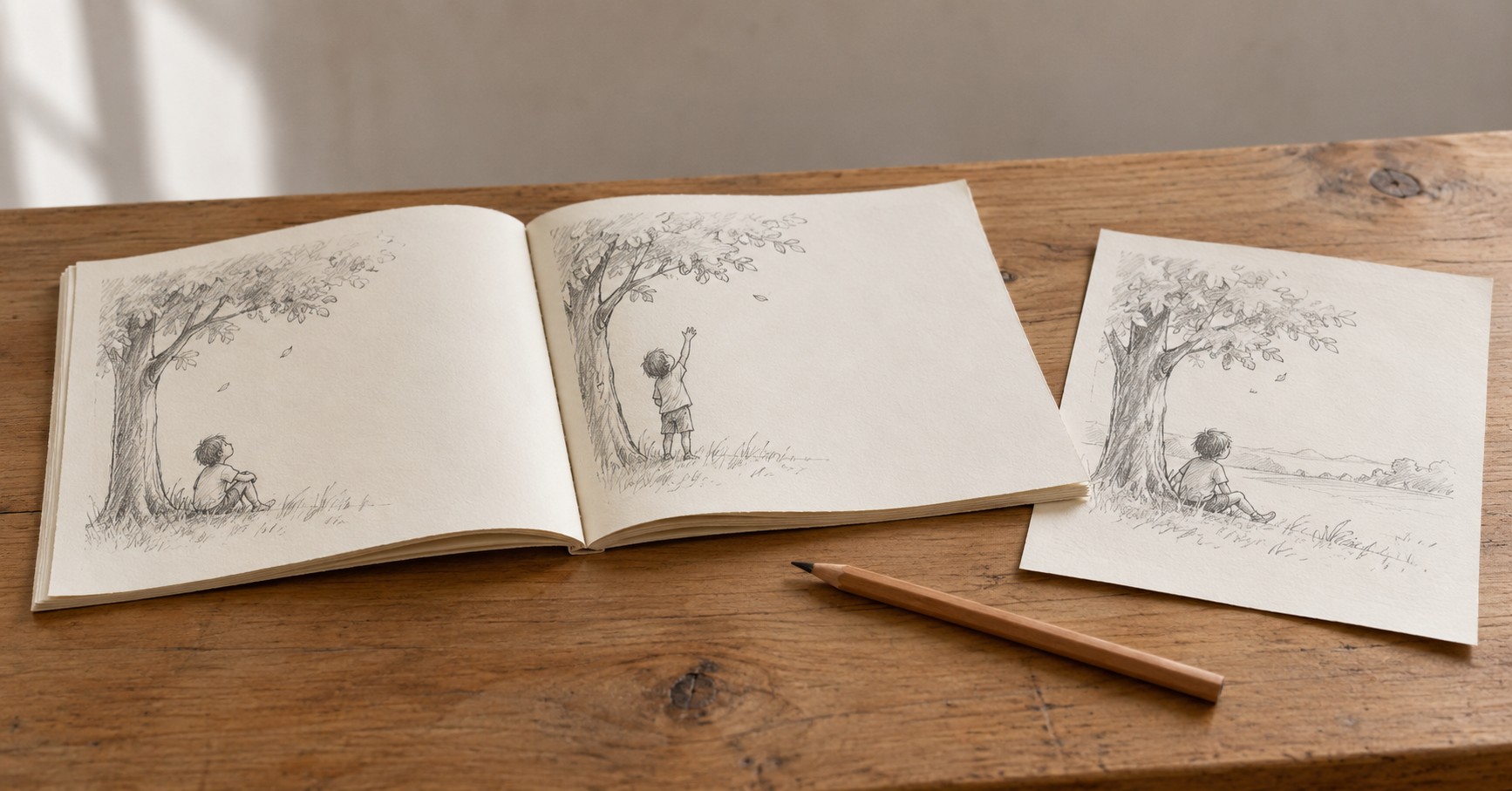
Approve your book’s drawings at the initial sketch stage, after checking the storytelling and choosing the direction I will develop across all the images. If you subsequently change the text, request a review of the scenes concerned: a structural rewrite during storyboarding changes the project’s scope.1, 2
When illustrating a book, I begin by clarifying the text, readership, format and intended uses. I then gather useful references and explore characters, atmosphere and composition. These explorations take place at the beginning of the process described for my book projects.1
Key takeaways
- Before the finishing stage, approve the meaning of each scene, the actions and text placement. Keep a short list of open decisions so you can discuss them separately. An overall assessment of the drawing benefits from precise agreement on what the reader should understand at this point.
- After a rewrite, present the new text alongside the version it replaces and request a review of the scenes concerned. Make this review a shared decision point: which images should be kept, which proposals should be reworked and which passages should remain open until the story’s intended meaning is settled?
- Designate someone to gather opinions and communicate the shared decision. If several readers provide feedback, ask each to specify the storytelling problem they want to resolve. When requests contradict one another, take the time to choose a shared intention before sending a new drawing request.
- Approval deserves precise wording: identify the version, approved scenes and elements still open. For reservations, state which decision is still pending and who needs to make it. I recommend asking for joint confirmation of the agreed starting point before continuing to develop the images concerned.
- To define the scope of corrections, distinguish feedback on a proposal in progress from new requests concerning a decision already approved. Ask for clarification of the reference document and the stages at which you want to give input. A request for reworking can then be discussed on the basis of a shared scope and the intended meaning.
Contents
- Can I start if my manuscript is still evolving?
- What should I check before approving the sketches?
- How should I read a sketched book layout as a whole?
- How should I give feedback on a drawing?
- What should I do if I want to rewrite a scene after approval?
- How should we agree on the scope of corrections?
Can I start if my manuscript is still evolving?
Yes, a manuscript that is still evolving may be suitable for me if the version is approximately 80% finalised and the remaining decisions are limited, assigned to specific people and given deadlines. Clearly present these open points before starting, since this possibility depends on their scope and a structural rewrite during storyboarding changes the scope of the project.2
When I receive a book enquiry, I check how the supplied materials fit my practice, schedule and the budget. If the project can proceed, we clarify the remaining questions, text, format, illustration plan and uses. The storyboard follows, before the final images.2 My guide “What should you prepare before entrusting a children’s book to an illustrator?” recommends a stable manuscript, the audience, tone, intended page count or format, publication method, budget and schedule. Consult this guide to prepare these elements, along with visual references that are genuinely relevant.2
What should I check before approving the sketches?
Before approving the sketches, check the action depicted, the characters’ intentions, text placement and what each scene contributes to the story. I advise expressing your agreement on these decisions, then identifying the questions still open so the illustrator knows exactly which direction you want to choose. In my illustration work, the first sketches help decide what the image should show, suggest or leave to the text. After this direction is approved, I refine the drawing, light, texture and colour. The decision about the image’s role therefore comes before this development.3
Prepare for an approval review with a specific question: what should the reader understand at this point in the story? For each scene, compare this intention with the proposed text and drawing. A colour preference deserves discussion, but begin with the meaning of the action and this scene’s place in the story. If a character trait is essential to the story, highlight it in your approval feedback. Distinguish the features needed to recognise the character from the details you leave open to interpretation. This hierarchy gives the discussion a specific focus: preserving the character’s identity while freely choosing their pose and expression.
To discuss text placement, use the words you actually want to keep. Look at where the eye should enter the page, then how it moves to the image. I advise flagging passages whose length remains uncertain so that you can discuss the space to reserve for them before giving your approval.
How should I read a sketched book layout as a whole?
Read the sketched book layout in story order, with the text placed on the pages, then return to passages that raise questions. I recommend looking at the sequence of actions and discoveries: what anticipation do you want to create, what information should you give now and which scene should have room to breathe before the next? At the beginning of a book project, I read the manuscript for its rhythm and visual moments. The storyboard tests the relationships between the text, the image and the next page. Character studies establish the shapes that will need to remain consistent throughout the project.4
In its 2018 article on creating a picture book, IngramSpark describes the dummy as a simplified mock-up of the final book, in black and white or colour, whose details must be defined. The article recommends requesting changes at this stage, before work on the final images begins.5
My guide “How many illustrations does a 32-page children’s picture book need?” explains how to divide the text into pages, then into visual moments. An image can occupy 2 pages; a page can contain 3 small vignettes. Consult this guide to examine this relationship between pages and compositions.6 Examine the transition from one scene to the next alongside the text planned for each. Ask yourself what information the reader has before turning the page and what discovery you want to reserve for the next passage. I recommend discussing this distribution when you are unsure whether to show an action or hold it back.
For my illustrated books, the first sketches allow us to check the storytelling before choosing a direction. Once this direction is approved, I develop the images as a whole with the aim of maintaining a consistent visual language. Clear decision points mark the progress of this work on the book.1 On my Books page, the 2 covers and the scenes from Tigrette & Lionard show how the characters, colour and linework relate to one another from page to page. Visit this page to look at these examples of visual relationships in the images presented.1
How should I give feedback on a drawing?
Give feedback on a drawing by identifying the scene, what you understand and the intention you want to convey. I recommend explaining the problem before proposing a visual solution, then indicating whether your comment concerns a storytelling necessity or a preference in treatment. When something in a drawing troubles you, first describe how you interpret it. For example, explain that the character seems hesitant when you want to convey a firm decision. Then leave room for a proposed drawing: the intention to convey provides a better starting point for discussion than an isolated instruction about form.
To assess the atmosphere, choose words that describe the feeling you want: tender, unsettling, lively, quiet. Then explain which element of the drawing brings you closer to this intention or takes you away from it. Feedback on atmosphere becomes more useful when it is grounded in a gaze, a distance or a relationship between the characters.
Gather your comments in a document linked to the version reviewed. For each passage concerned, identify the scene, intended meaning and requested correction. I recommend prioritising feedback as essential decisions, questions to discuss and preferences, to give the next conversation a clear order. Designate someone to gather opinions and communicate the shared decision. If several readers provide feedback, ask each to specify the storytelling problem they want to resolve. When requests contradict one another, take the time to choose a shared intention before sending a new drawing request.
What should I do if I want to rewrite a scene after approval?
If you want to rewrite a scene after approval, send the approved passage, new text and reason for the change before requesting further work on the images concerned. I recommend reviewing the action, characters present and neighbouring scenes together, then specifying which decisions need to be reopened.
In a fictional example, a child hides a letter in the drawn scene, then the rewritten text has the child give that letter to their sister. Ask what action should be depicted and what reaction is expected. Then examine whether the next scene should still show the letter hidden or now received. When reviewing a rewrite, also go through the scenes that lead into the passage and those that follow it. Look for elements to reopen for discussion: the presence of an object, a character’s intention, the setting or the order of actions. I recommend drawing up this list before deciding which images you want to keep as they are.
How should we agree on the scope of corrections?
Agree on the scope of corrections by specifying the versions reviewed, feedback stages and decisions expected at each presentation. I also recommend discussing new requests after approval and manuscript changes, so that you share an understanding of when reworking needs a new discussion. To define the scope of corrections, distinguish feedback on a proposal in progress from new requests concerning a decision already approved. Ask for clarification of the reference document and the stages at which you want to give input. A request for reworking can then be discussed on the basis of a shared scope and the intended meaning.
The AOI’s Guide to Commissioning excludes additional fees for minor alterations and those caused by an artist’s error. It states that the illustrator may charge reasonable fees for significant changes that were not included in the initial brief.7 According to the AOI’s Guide to Commissioning, the illustrator may reasonably expect additional payment when extra rounds of sketches are requested beyond the initial brief. This guidance concerns requests that exceed what was planned; it expresses the possibility of additional payment without specifying an amount.7
The guide from Illustrators Ireland and the AOI recommends specifying deadlines for delivering sketches, approving them and delivering the final images. It states that waiting for approval can eat into the time reserved for producing the final images. Response time therefore forms part of the recommended schedule.8
Agree on what each presentation should allow you to decide. For sketches, formulate questions about the action, framing and text placement; for a developed image, prepare comments on the visual treatment. I prefer an explicitly stated expectation to a general request for approval whose criteria remain implicit. Approval deserves precise wording: identify the version, approved scenes and elements still open. For reservations, state which decision is still pending and who needs to make it. I recommend asking for joint confirmation of the agreed starting point before continuing to develop the images concerned.
Keep separate records of the proposals discussed and the decisions agreed. A working folder can bring together the approved manuscript, corresponding book layout and outstanding reservations. I recommend agreeing on a shared version name, then using it in feedback to identify exactly which document needs to be reviewed.
Frequently asked questions
How can I distinguish a text correction from a change in storytelling?
To distinguish a text correction from a change in storytelling, compare the meaning, action and information given to the reader before and after the change. I also advise examining the passage’s length and position on the page, then presenting the differences to the illustrator before characterising the revision. When a text change seems necessary, send the current passage and proposed replacement together. Add the reason for the rewrite: clarifying an action, moving information or changing the tone. This presentation allows you to discuss the intended meaning before deciding which visual decisions need to be reconsidered.
Who should communicate approval when several people are involved in the book?
Approval should be communicated by someone designated to gather opinions and express the shared decision on the book. I advise choosing this person during preparation, then entrusting them with resolving contradictory feedback before asking the illustrator to develop or rework a proposal.
How should I express approval with reservations?
Express approval with reservations by explicitly separating approved decisions from questions still open on the version reviewed. I recommend specifying the desired correction or expected discussion for each reservation, then agreeing which images can continue to be developed along the direction already chosen.
What should I look at when approving the final images?
When approving the final images, look at the drawing alongside the agreed text, at the intended size, and compare each scene with the approved decisions. I advise examining readability, expressions and details useful to the story, then precisely describing the discrepancies you want to reopen for discussion.
Sources
- Livres
- Que préparer avant de confier un livre jeunesse à une illustratrice ?
- Illustration
- Ce que le dessin d’observation apporte à l’illustration jeunesse
- IngramSpark 2018
- Combien d’illustrations faut-il pour un album jeunesse de 32 pages ?
- Guide to Commissioning
- Illustrators Ireland and the Association of Illustrators (AOI), A Guide to Commissioning Illustrators
Nicole Hénusse, Illustrator and author