9 minutes of reading
Key takeaways
- An accurate photograph helps customers choose a product based on its appearance by showing precisely the detail that matters.
- An illustration of a support service becomes more accurate when it depicts a real interaction described and validated by the team.
- The review by Levie and Lentz (1982) compares learning from illustrated text with learning from text alone across 55 experiments.
- In the study by Bellaiche and his coauthors (2023), images that were all generated by AI were liked more and considered more valuable when presented as created by a human.
- The brief must specify the message to convey and the intended formats so that the images can be checked for relevance to the text and legibility after cropping.
In this article
- When do your customers need to see the actual product?
- How do you illustrate a service that cannot be photographed?
- What does research say about an image’s relevance?
- Does handmade work add value to your brand?
- What should you plan for when adapting an illustration across your brand identity?
- How should you choose your next photos or illustrations for your brand image?
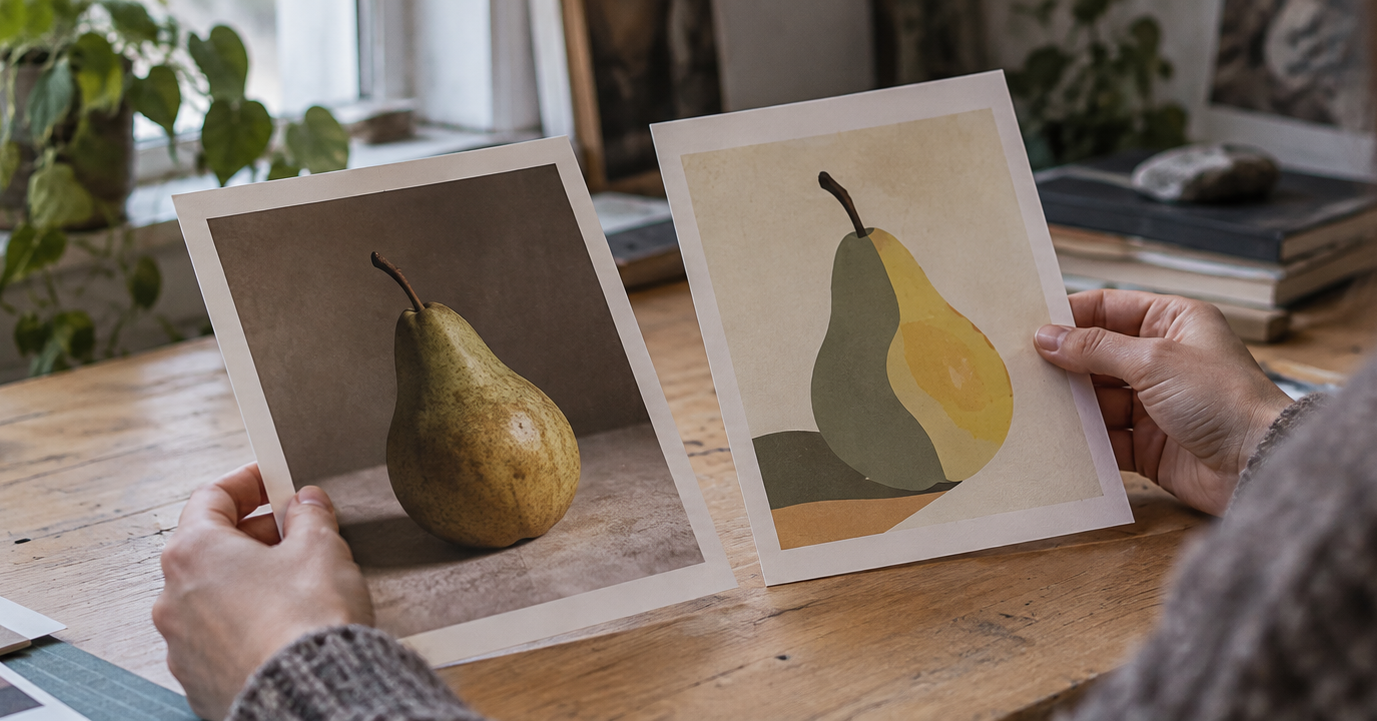
Favour photography to show a verifiable reality. Illustration serves to represent an idea or give your brand identity a distinctive visual language. You can combine them according to their uses. A brand does not have to choose a single form of expression for all its images. The choice depends on what each image needs to make visible.
When do your customers need to see the actual product?
Your customers need to see the actual product when their choice depends on its appearance. Think of the grain of paper or the way a garment hangs on a person. An accurate photograph provides access to these visible details. A drawing may simplify outlines or interpret a material. It then leaves an open question about what the buyer will receive. For illustrated books, a photo of the open book shows, in particular, how the images occupy the double-page spread. It also shows what the binding conceals in the centre. An illustration presented alone does not allow these two elements to be examined.
Accuracy does, however, depend on how the photograph is taken. Very harsh lighting can accentuate the texture of paper. Colour retouching can make the photographed cover look different from the copy in your hands. Even a carefully taken photograph remains a partial view of the product, with a chosen angle and areas outside the frame. To assess a finish on the back of an object, the customer needs to be able to see that back in a dedicated image.
Before taking the photograph, start with a specific question the buyer might ask about the product’s appearance. Then position the object so that the answer is visible without the buyer having to guess. Show the detail that matters. If the question concerns the texture of a cover, plan a close-up sharp enough to distinguish its surface. Accompany it with a view of the whole book to put that detail in context. Then compare the images with the copy photographed. Above all, check that the framing and retouching do not erase a characteristic the customer will discover on receipt.
How do you illustrate a service that cannot be photographed?
To illustrate a support service, start with a real situation the team can describe precisely. Then choose the moment when the help provided becomes visible in the relationship between the people. Take a hypothetical example: an ASBL helps a person understand an administrative letter. The scene to draw could show this person holding their letter while the support worker points to a passage. Both would be seated at the same table, with the document between them. The gesture must correspond to the help actually offered. Before drawing, therefore, ask the team to describe an interaction of this kind. Ask them to specify what each person does. You can then choose who holds the letter and where their eyes are directed. Then submit this scene to the ASBL to check that it accurately represents the support it provides. This check also concerns the space given to the person receiving help.
“Illustration serves to represent an idea or give your brand identity a distinctive visual language.”
Discover Nicole’s illustrated books and editorial work.
Two published children’s books, editorial commissions and identities drawn by hand.
What does research say about an image’s relevance?
The review by Levie and Lentz (1982) examines the role of illustrations in learning from text. It brings together 55 experiments comparing illustrated text with text alone. This comparison is not enough to establish that drawing is generally superior to photography.
Applying this conclusion to a brand identity requires distinguishing the question studied from the question you face. The research concerns learning from illustrated content. You need to choose between a photo and an illustration for a particular communication. Only a comparison of these two forms of image against the same objective could support the claim that a drawing would be more effective than a photo or offer a commercial advantage.
For an editorial illustration commission, I would take a question from this review to include in the brief. Which passage of the text should the image help readers understand, and which visible elements will establish that connection? This question translates Levie and Lentz’s finding into a working instruction. If a proposal accompanies a text without representing its content, its aesthetic appeal may be part of your choice. But this review alone does not support an argument for its value to your brand.
Does handmade work add value to your brand?
Handmade work can shed light on the perceived value of an image. But the study by Bellaiche and his coauthors (2023) does not support a promise of increased value for your brand. The researchers randomly assigned the labels “created by a human” or “created by AI” to images that were all generated by AI: those presented as human creations were liked more and considered more valuable. The attribution of the work therefore matters. The authors also report that this effect varied with the perceived effort behind the work and its perceived narrativity. This experiment tested only the stated origin of the images, without measuring actual manual work or the commercial value of a brand identity.
For your commission, first decide whether you want to make the illustrator’s work visible. If this approach matters to your project, ask to be able to show a sketch and explain a drawing choice, with the illustrator’s agreement. Keep the wording accurate. An illustration drawn on a tablet can be attributed to its creator while specifying the tools used. Do not imply that it was made on paper. If your main aim is to justify a higher price through a handcrafted appearance, this study does not give you sufficient evidence to base that decision on.
What should you plan for when adapting an illustration across your brand identity?
Include the dimensions of your materials and the necessary crops in the brief from the start. Then check that the illustration remains legible on a label as well as on a web page. Framing is part of the drawing. A character placed near the edge may disappear in a narrow version. A detail visible on screen may become difficult to distinguish on a small printed label. For your brand identity, ask to review these uses before approving the composition.
- Include the formats in the brief. Specify the actual dimensions of the label and the intended placement on the web page, including its shape on a phone. Add the text that needs to accompany the image: its position matters from the first sketch.
- Identify what must remain visible. Depending on the drawing, this might be a face or a gesture. Ask for a composition that keeps this element in every planned crop, with enough space around it to avoid an awkward cut.
- Examine the trials at the size they will be used. Print the label at its final dimensions. Also view the page on a phone: check whether the essential detail is still distinguishable and whether the text overlaps the drawing.
- Specify the versions to deliver. Have the selected adaptations and corresponding files included in the commission. If a simple crop cuts off a necessary element, ask whether a composition adapted to that format is included in the quote.
To compare a bespoke commission with an existing visual, use these same formats. An existing image may work as it is. If it requires moving elements or reworking the drawing, include that work when comparing costs and timelines.
How should you choose your next photos or illustrations for your brand image?
To choose your next images, start with a priority medium. Write in one sentence what your customer needs to understand from it. Then compare the proposals on that medium, alongside its text. Which photo or illustration expresses the message you wrote down most clearly? Before commissioning, ask for the proposals to be accompanied by an explanation of their connection to that message. You can then discuss the choice on a precise basis.
Frequently asked questions
Is an accurate product photo enough to communicate the brand effectively?
Product accuracy and message relevance require separate checks. A photo can depict its subject correctly without conveying what you want to say in the chosen medium.
How do you choose between visuals that convey the same message equally clearly?
How they work in the planned formats can help you choose between them: an essential detail may become illegible at the final size. Also compare the adaptation work required, which can change the cost and timeline for an existing image.
Is a scene approved by your team ready to publish?
The team’s agreement on the scene depicted does not guarantee that its layout will preserve the drawing’s meaning. Check that the framing retains the gesture that explains the support provided and that the text does not conceal it at the size it will be used.
Does the cited research justify an illustration costing more than a photo?
This research does not justify the additional cost. It concerns learning with images linked to text or the stated origin of a work, without establishing a commercial advantage for drawing or a price justification for your commission.
How can you combine product photos and sketches in brand communication?
You can give them complementary roles: photos show the product’s appearance, while sketches allow you to explain a drawing choice. To share these sketches, ask for the illustrator’s agreement and specify the tools used without suggesting work on paper if the drawing was made on a tablet.
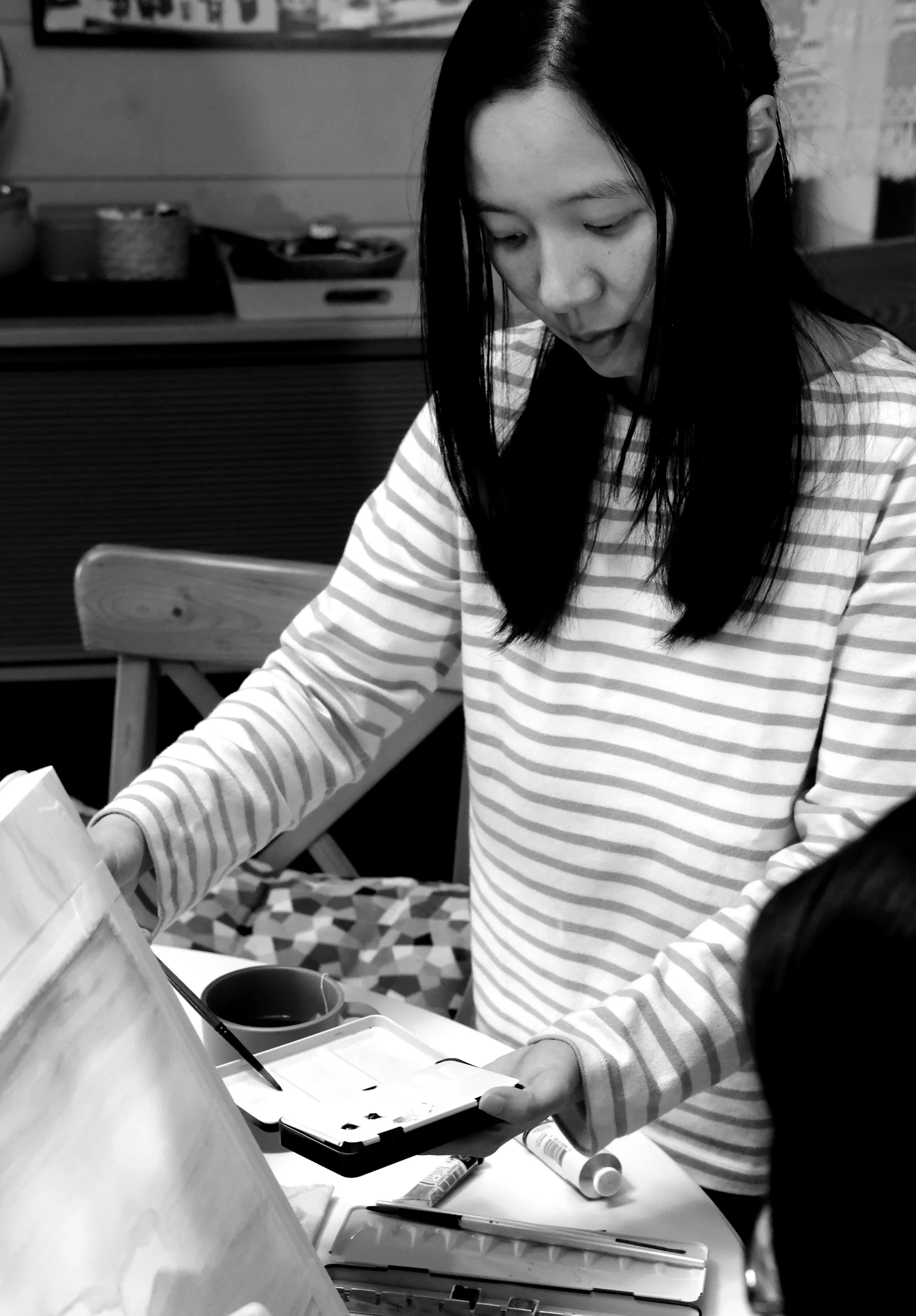
Nicole Hénusse · Illustrator and author
Nicole Hénusse is an illustrator and the author of two published children’s books, based in Belgium. Her practice brings together illustrated books, editorial illustration, brand identities drawn by hand and observational drawing.
Do you have a book to illustrate or an editorial project?
Nicole takes on a small number of projects each year. Tell her about yours.