To assess whether an illustrator will be able to illustrate your children’s book, I recommend comparing her portfolio with the situations in your manuscript and asking her to explain her choices. Your preference for her drawings then becomes a reasoned assessment of the storytelling, characters and place of the image in your project. For educational illustration, the Association of Illustrators recommends a lively and engaging portfolio, with clear examples in several formats. Commissioners look for both full scenes and very small spot illustrations in it.1
Before browsing a portfolio, put into words the reading experience you want your book to offer. Are you looking for a lively adventure, a sense of closeness to the character or a contemplative atmosphere? I recommend keeping this intention to hand as you examine the images you like. An annotated selection benefits from linking each chosen image to a specific reason. Note what interests you, then the question this observation raises for your manuscript. I prefer a conversation informed by these connections to an accumulation of references whose role would remain difficult to explain.
Key takeaways
- Choose images to discuss based on the situations your story will need to make visible.
- Connect your liking for a drawing to specific choices of gesture, composition and atmosphere.
- Give small images attention proportionate to their role in your book.
- Turn your concerns into explicit questions to examine with the illustrator.
- Leave room for the artistic proposal while specifying the essential intentions of your story.
Contents
- How can I relate a portfolio to my manuscript?
- What should I look at in a full scene?
- How can I assess a small spot illustration?
- What should I look for in characters’ expressions?
- How can I examine a sequence of images?
- What role should text play when assessing the images?
How can I relate a portfolio to my manuscript?
To relate a portfolio to your manuscript, I would start with the situations the images will need to convey, then look for connections with the works shown that you can explain. Choose a representative narrative challenge and ask the illustrator which work provides a basis for discussing it, including its similarities to and differences from your story. Does a character need to hide their worry, cross an unfamiliar place or make sense of a misunderstanding? This specific question provides a starting point for discussing the relevance of a portfolio with the illustrator.
The My Method page presents the foundations of my training in drawing from life, including figure construction, anatomy, light, perspective, volume and composition. I also describe my training in visual communication and my practice of digital painting.2 Ask the illustrator which aspects of the work shown reflect her own choices and which responded to a particular request. I recommend discussing the role of the image and the project’s constraints. This distinction provides a framework for discussing what you would like to see in your book.
Jessica Boehman’s course published on LibreTexts recommends making one’s artistic voice evident in the works of a portfolio. It also asks that the works look as though they were created by the same person.3 To compare approaches, use the same excerpt, intention and questions. Describe separately your enjoyment of the drawing, your reading of the scene and your questions about the project. I then recommend deciding which criteria matter most for this particular book and its storytelling.
What should I look at in a full scene?
In a full scene, I would look at how the action, characters and setting are arranged to convey an intention. Describe what you understand at first glance, then ask yourself which elements deserve closer attention and how this approach to composition might suit an important scene in your own book. In my article “Ce que le dessin d’observation apporte à l’illustration jeunesse” (in French), I comment on a scene of a little girl with her dog. I explain how the leash, the orientation of the body and the line of the path organize the relationship between the foreground and the village.4
In a setting, I would look at the relationship between the place and the action. Look for routes, obstacles and objects the character could interact with. For your manuscript, specify what needs to be understood about the place, then discuss the freedom given to the illustrator to create its atmosphere.
A discussion of a concern deserves a specific example. Point to the gesture that surprises you, the passage that seems confusing or the atmosphere you interpret differently. I recommend explaining the intention of the text, then listening to the artistic proposal so you can choose together which issue calls for revision.
How can I assess a small spot illustration?
A small spot illustration seems appropriate to me when its intention remains easy to describe within the space you intend for it. To assess it, I would choose the gesture or detail essential to your passage, then examine with the illustrator the space given to that element and the simplifications that would be desirable for your page.
The Association of Illustrators recommends presenting some portfolio images in product mockups to give art directors context. The examples suggested include children’s yoghurt packaging, an item of clothing and a puzzle.1 Plan to discuss the placement of text as you look at compositions that interest you. Where would you like to read the words and which part of the image would you like to keep clear? I recommend asking these questions with the intended format in front of you, even if the layout has yet to be defined.
What should I look for in characters’ expressions?
In characters’ expressions, I would look for an emotion connected to a situation you can explain in your own words. Examine the face together with the posture and the relationship to other characters, then discuss the degree of precision you want for your story and how much interpretation you want to leave to the reader. When an emotion feels right to you, try to pinpoint what makes you read it that way.
Compare characters seen from different angles using simple reference points, such as their silhouette, attitude and distinctive details. I also recommend looking for expressive variations you like. The discussion can then focus on how your character would remain recognisable while experiencing different situations. The Association of Illustrators recommends depicting diverse people in a portfolio intended for children’s illustration. It links this recommendation to representing contemporary society and to the possibility of meeting the needs of commissioners based in different parts of the world.1
How can I examine a sequence of images?
To examine a sequence of images, I recommend describing the change each one brings and the reference points that allow you to follow the character. Also look at the transition between scenes, then ask what progression you would like in your book and which pauses would deserve a particular place. On the Books page, I present the two covers and scenes from Tigrette & Lionard as examples of the relationships between characters, colour and line from one page to the next.5
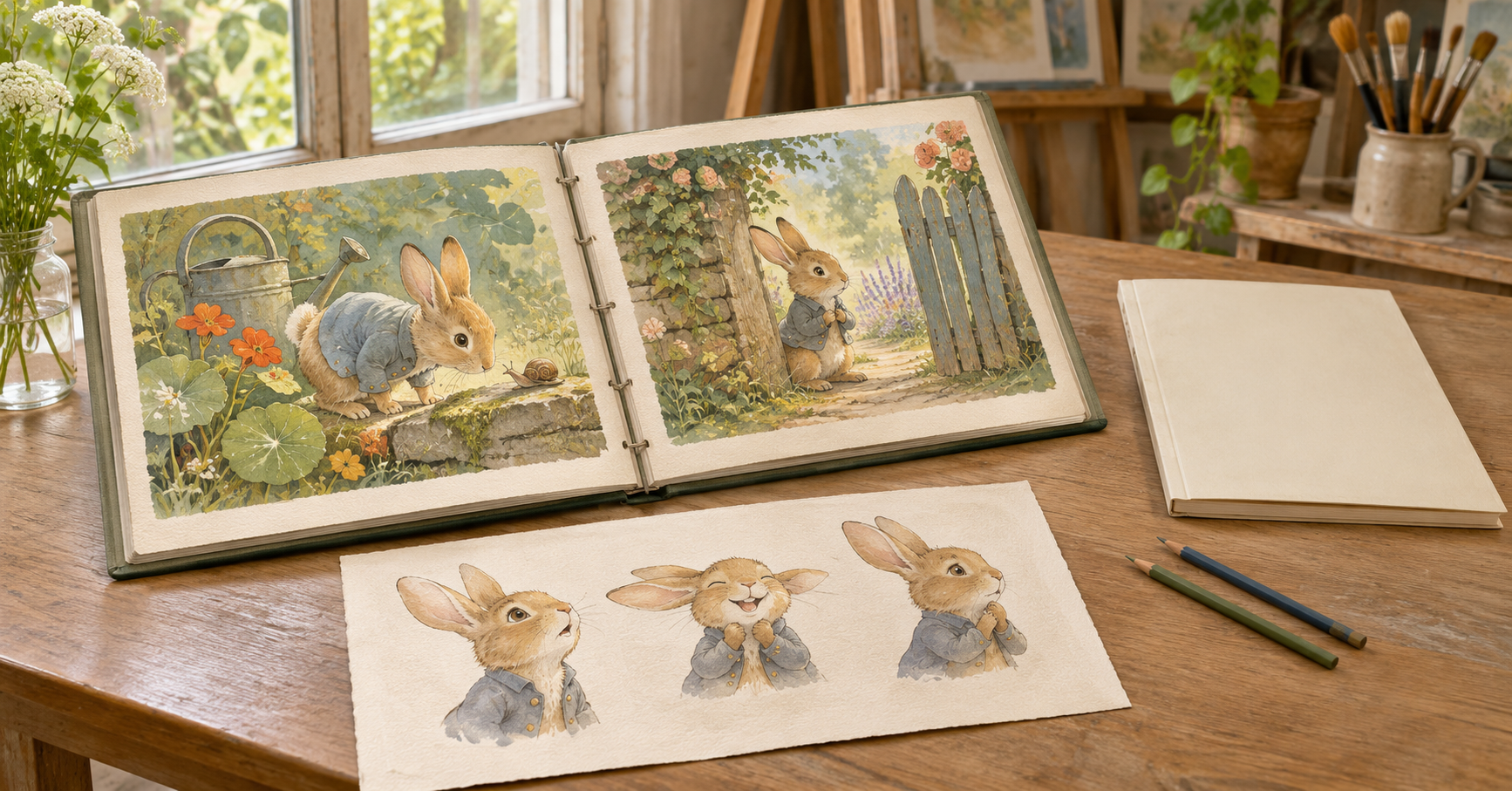
In a fictional example, a rabbit discovers a door standing ajar, approaches it and then hesitates at the threshold. To discuss the drawing, I would look at the curiosity in the initial gesture, the direction of movement and the final restraint. Each image would be examined for its contribution to this small progression. At the beginning of a book project, I read the manuscript for its rhythm and visual moments. The storyboard tests the relationships between text, image and the next page, while character studies establish the forms to maintain. After approval, I develop the images with the whole book in mind.4
I work in gouache, watercolour, pastel, charcoal and ink, then I can finish the image digitally as a painting or vector artwork. The choice of technique comes from the project.6 To discuss colour, describe the atmosphere you want and the moments when you would like it to change. A palette you like in an image can serve as a starting point for this exchange. I would then ask how this direction would be interpreted in the calm, tense or joyful passages of your own story.
What role should text play when assessing the images?
To assess the images for your book, I would give the text an explicit place in the discussion of the page. Specify what the words need to convey and what you would like to entrust to the drawing, then examine how the two come together through the intended composition and the rhythm of the passage. Sophie Van der Linden explains that the narrative function or placement on the page can lead readers to perceive the text or the image first. The other form of expression then confirms, contradicts or amplifies this initial message.7
The Bibliothèque nationale de France’s educational resource on picture books describes a graphic role for the writing itself, when typographic treatment turns it into an image. It also discusses the physical variety of the formats, including square and oblong books or pages that unfold like an accordion.8 IngramSpark’s article published in 2018 recommends preparing a rough plan of the content for each page. It points out that some pages contain elements outside the story, including the title and copyright.9
The same article describes the dummy as a simplified mock-up of the final book, in black and white or in colour, with defined details. The article recommends requesting changes at this stage, before the illustrator begins the final images.9 It also recommends having a satisfactory, properly edited manuscript before proceeding with the project. The article warns that changing the words after the illustrations are completed can cause problems.9
If the portfolio does not show a situation important to your story, keep this point as an open question. Ask which works would help you discuss it and how the illustrator would approach the scene. I recommend basing your assessment on the available material, clearly identifying what remains to be examined. Before choosing, bring together what convinces you and the questions still open in a short note. I recommend distinguishing the artistic choices you wish to entrust to the illustrator from the elements essential to your story. This division provides an explicit basis for the working relationship you are considering.
Frequently asked questions
Do I need to find my exact subject in the portfolio?
I would prioritise the narrative relevance of the works to your project, since a similar subject still leaves choices of composition and expression to discuss. If your specific subject appears rarely in the portfolio, ask the illustrator which examples shed light on her approach and what research she would propose for tackling your story.
How can I choose between several styles I like?
Among several styles you like, I would choose the one whose connection to the tone and situations of your book you can explain. To decide between your preferences, compare each direction with the same passage from the manuscript and describe the reading experience you want to offer through the images.
What should I ask the illustrator about her choices?
I would ask the illustrator to explain a choice of framing, gesture or colour in a work you have selected. Then relate this explanation to your manuscript and ask which point she would like to explore first, so you can discuss an artistic proposal using reference points you both understand.
How can I decide after looking at the portfolio?
After looking at the portfolio, I would decide based on the specific connections with your book and the quality of your exchange about open questions. Keep a record of shared intentions and concerns discussed, then check that you are comfortable with the artistic freedom you wish to entrust to the illustrator. For an initial contact, you can send me a document, a PDF or a private link, accompanied by a brief summary. To prepare the illustration plan and quote, I need to read the text itself.10
Sources
Sources 1 to 5
Sources 6 to 10
- À propos
- Bibliothèque nationale de France, Centre national de la littérature pour la jeunesse (CNLJ), Article de Sophie Van der Linden sur la mise en page de l’album (Revue des livres pour enfants)
- Bibliothèque nationale de France (BnF, site pédagogique Classes), Dossier pédagogique : les albums
- IngramSpark 2018
- Que préparer avant de confier un livre jeunesse à une illustratrice ?
Nicole Hénusse, Illustrator and author