The short answer
Do not choose between an illustrator and an AI image tool by comparing one polished picture. Ask for three connected scenes. The character must remain recognisable while moving, changing expression and occupying a different composition. Then test a revision and establish who will carry the visual decisions through layout, technical preparation and final delivery.
AI can be useful for reference gathering, early visual exploration or a deliberately generative project, provided the tool and its terms suit the work. An illustrator becomes especially valuable when a manuscript needs recurring characters, controlled page rhythm, considered revisions and one person responsible for the sequence as a whole. The decision is about the workflow the book needs, not a contest between labels.
ASSET: rabbit-sequence-01
A single image hides the difficult part
A cover-style image can look resolved while leaving the central production question unanswered: can the same visual world survive the next scene? A story asks a character to turn, crouch, carry something, enter a new room and respond to another character. Scale, costume and facial structure need to hold together, but a rigid copy of the first pose is not enough.
Continuity also includes the details around the figure. A room needs stable landmarks. A prop cannot change shape each time it appears. The direction of a gaze should support the action. Space for text has to be considered before the image is treated as finished. And the tempo of a spread may call for quiet, while the next image needs movement.
Research in visual story generation treats this as a distinct technical problem. Chen and colleagues describe globally consistent image sequences and character preservation as central requirements of story visualisation. StoryDiffusion later proposed a specific attention mechanism to improve consistency across generated images. The point is not that generated sequences cannot work. It is that continuity calls for controls beyond a strong prompt and an attractive first result (Chen et al., 2022, Zhou et al., 2024).
What should remain stable, and what should change?
Start with identity. Record the character’s proportions, silhouette, face, hair or ears, clothes and recurring objects. Then define the world around them: the important features of a room, the palette, the source of light and the relative size of the cast.
Now make the test difficult enough to be useful. Consistency is not the same as repetition. The character should be able to look sleepy, worried or delighted without becoming a different person. A method that protects likeness only by repeating a front-facing pose has not yet demonstrated narrative range.
Three prompts or sketch briefs can expose the difference:
- a quiet close scene involving two characters;
- an action that changes both silhouettes and body positions;
- a wider or vertical scene in which a story object passes between them.
Look at character identity, but also at gesture, spatial logic and the connection between one moment and the next.
ASSET: rabbit-sequence-02
ASSET: rabbit-sequence-03
A five-scene example: Mother and Daughter Rabbits
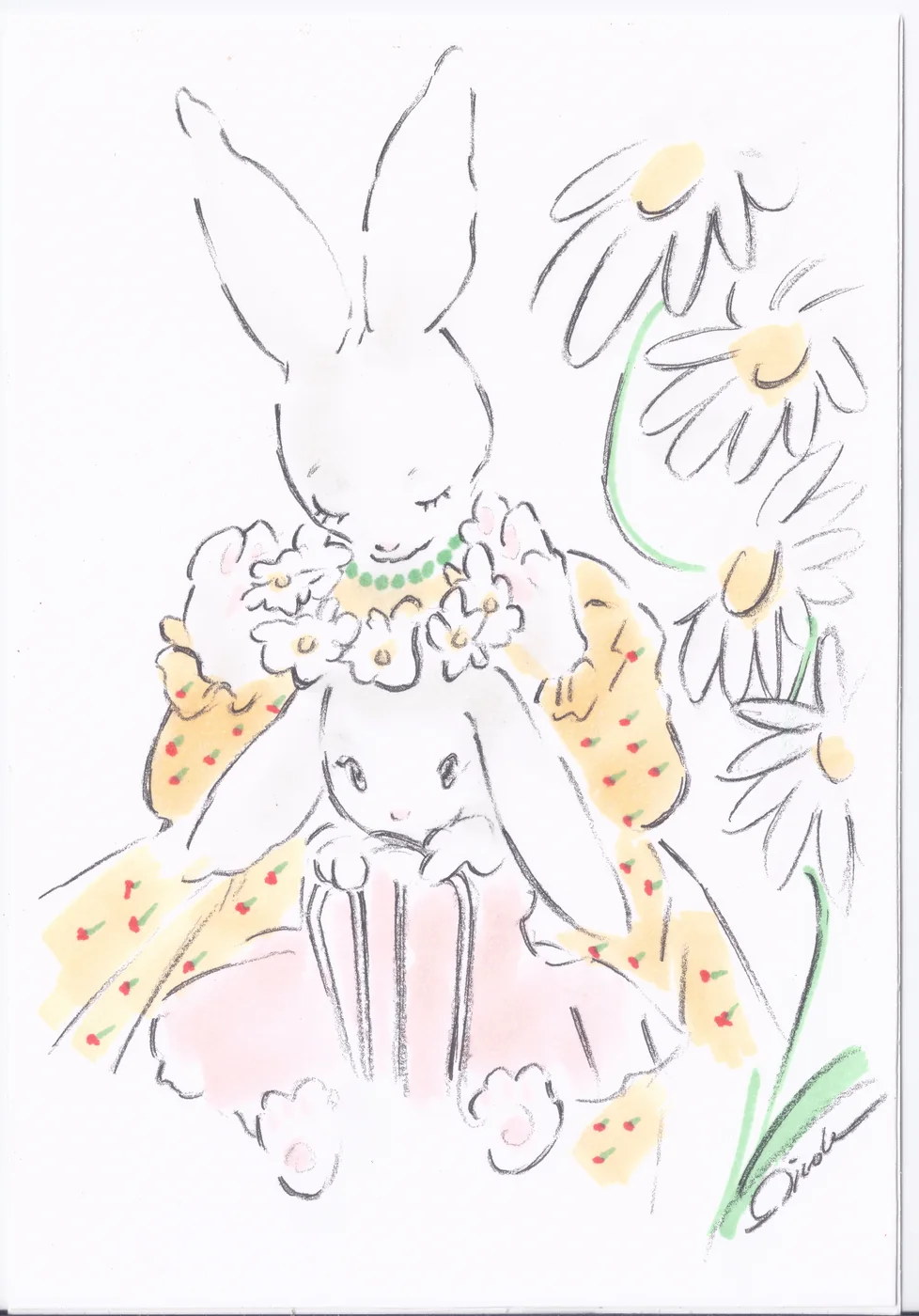
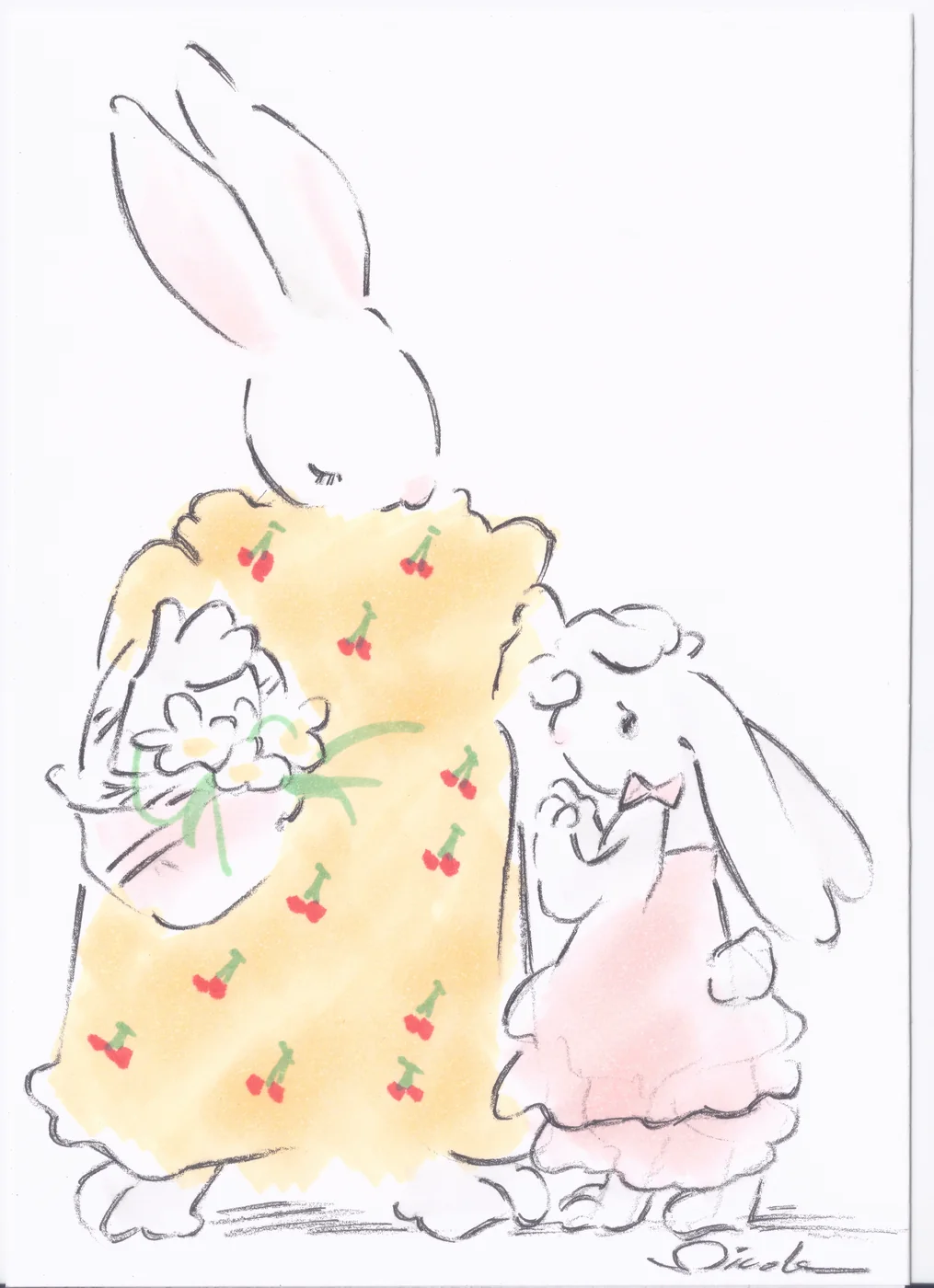
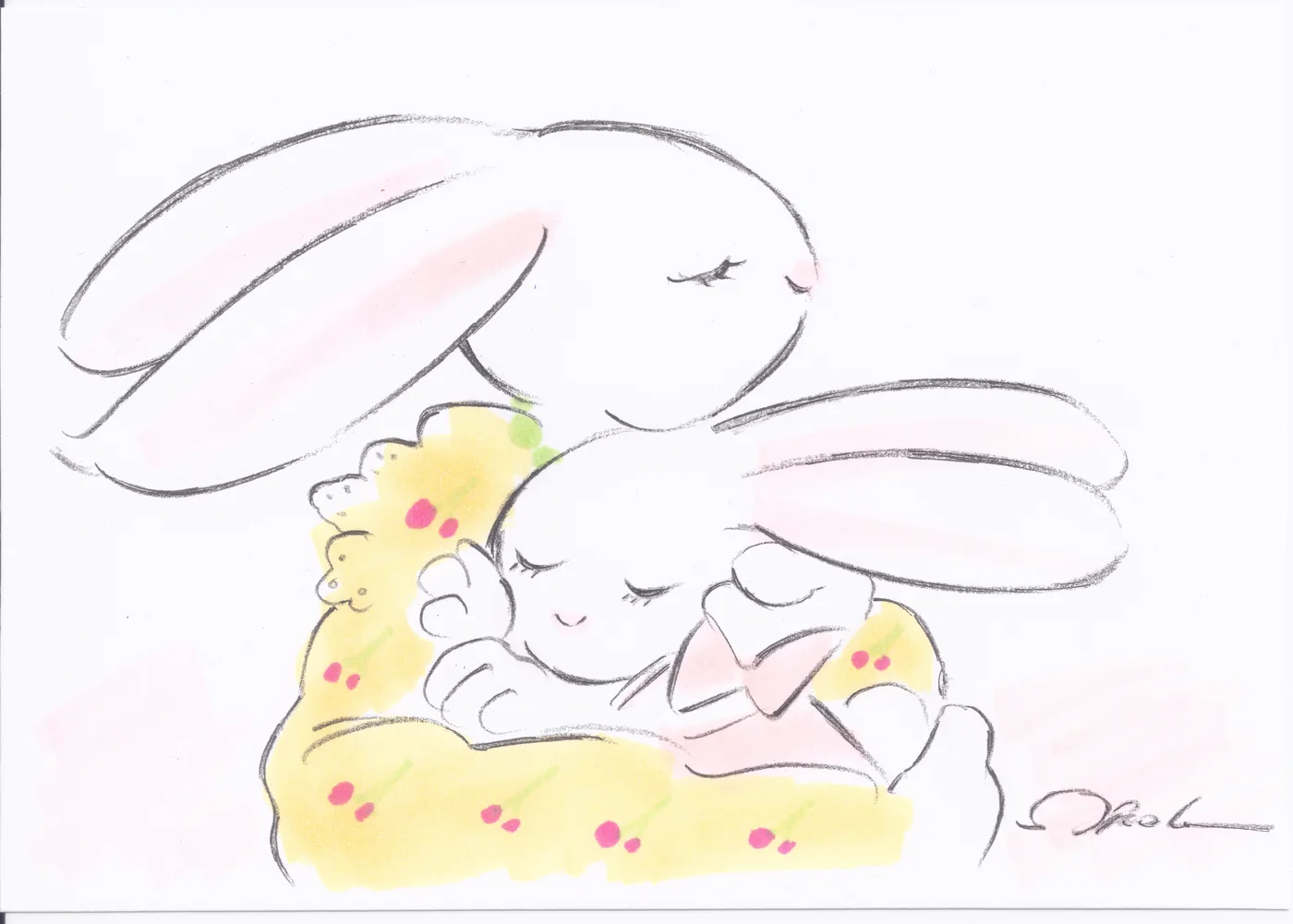
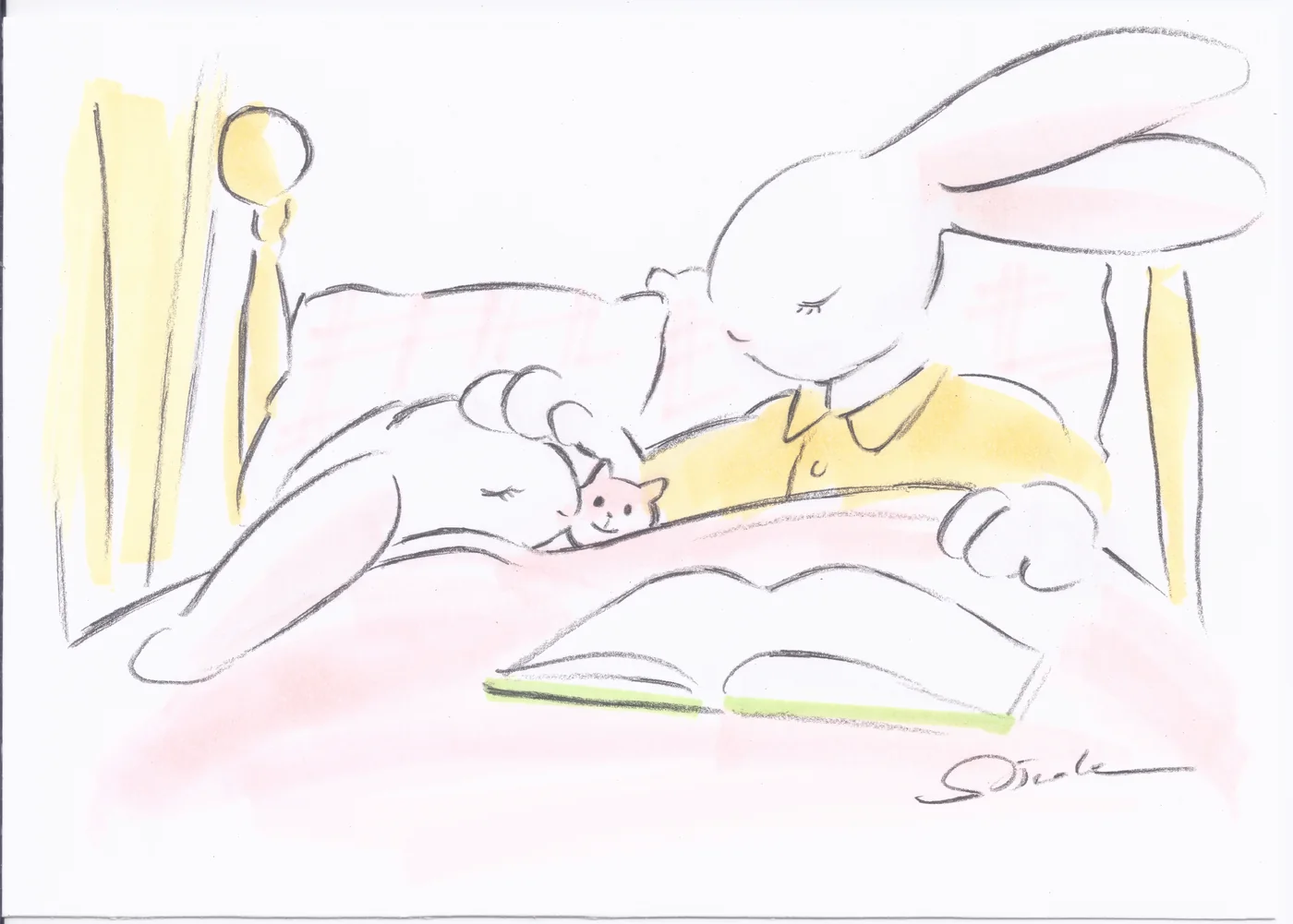
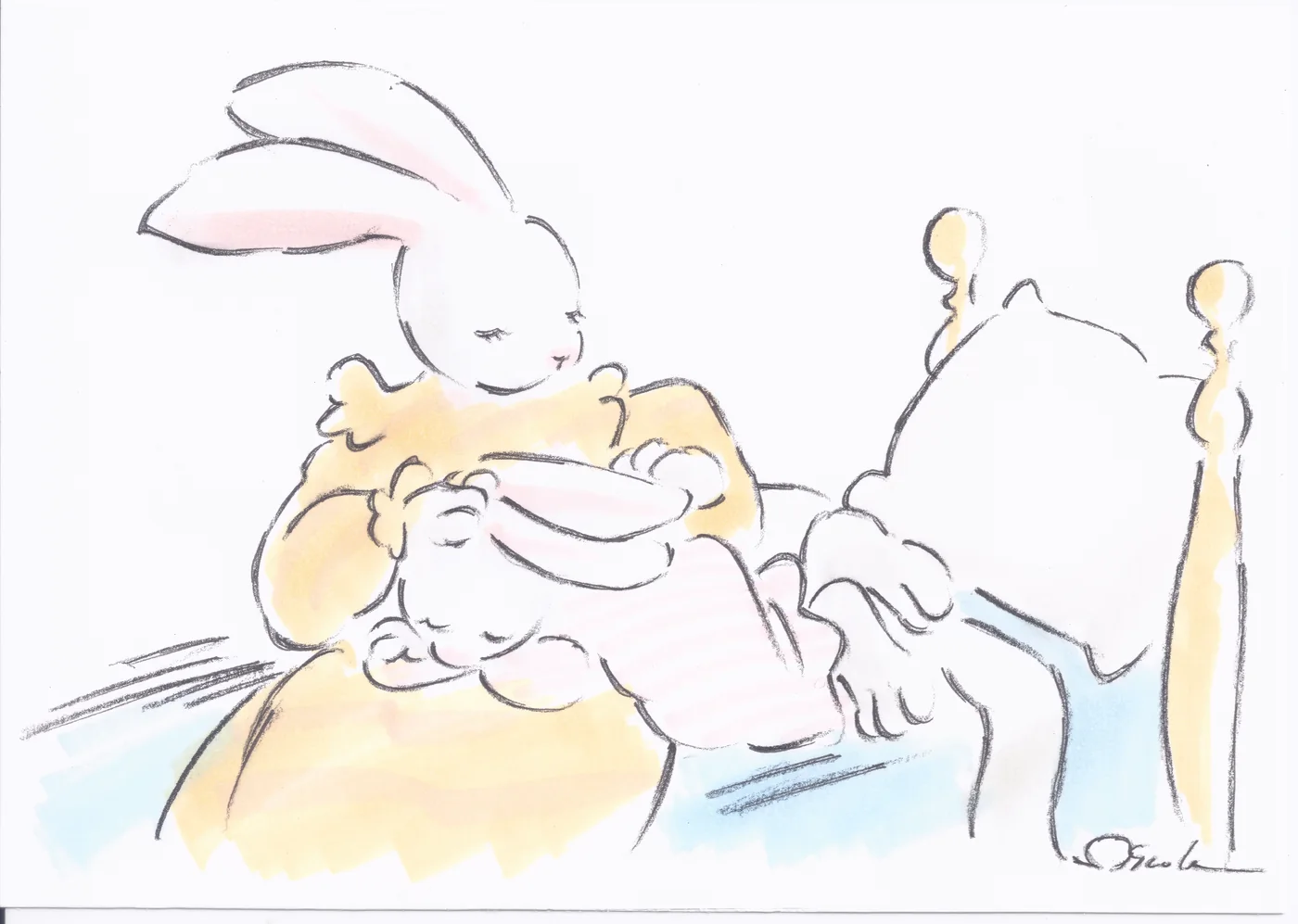
My Mother and Daughter Rabbits sequence is shown on the Books page. It begins with the mother watching over the sleeping child. She reads beside the bed in the second scene and carries the young rabbit in the third. The last two drawings change to portrait compositions: the mother places a daisy crown on her daughter, then receives a bouquet from her.
The figures remain legible through a small set of repeated choices. Their relative sizes do not drift. The mother’s yellow cherry-print dress and the daughter’s pink clothes separate them at once. Pencil line, pale colour and open paper give every scene the same visual voice. Within that frame, the ears, hands, expressions, distances and compositions keep changing.
This is the useful design question behind a character sheet: which features are fixed, which may flex, and what does each gesture add to the next moment? I test those decisions through character studies and composition sketches before a whole series is finalised. Solving the system at the study stage avoids discovering conflicts after the full set is finished.
ASSET: rabbit-sequence-04
ASSET: rabbit-sequence-05
Can an AI system keep a character consistent?
Some can do far more than a basic text prompt. DreamBooth demonstrated subject-driven generation by fine-tuning a model on a small set of reference images. Other research focuses directly on consistency across a run of images (Ruiz et al., 2023). These methods are developing quickly, so sweeping claims about what “AI always does” will age badly.
For a real commission, the better questions are operational. Who builds and checks the references? Who selects the useful outputs? Who redraws a hand, expression or room when it shifts? What happens to the neighbouring pages when one scene is revised? Does the chosen service permit the intended use of the material supplied to it? Those points should be settled in the project terms rather than assumed.
A generative workflow may be a good fit for exploratory work or a project that wants visible variation. A book with a recurring cast may still use such tools, but its budget and timetable need to include direction, selection, correction and production. The generation time alone is not the whole job.
What does an illustrator contribute to the sequence?
An illustrator can read the manuscript before deciding what any single picture should contain. That makes it possible to leave information in the words, reserve an expansive image for a turning point, or introduce a small visual element that becomes meaningful later. A character study can cover weight, posture, habitual gestures and relationships, not only a standard view of the face.
My process begins with the text, the reader, the format and the job of the images. Early studies test character and storytelling. Once a direction is chosen, drawing, colour and composition are developed as a shared system across the series. My Method explains that progression.
Working with a person does not mean that the first sketch is beyond revision. It means there is an accountable visual partner who can explain a decision, alter it in relation to adjacent pages and keep the book’s direction in view through final production.
Run this small test before committing to a full book
Choose three consecutive moments from the manuscript. Add the proposed trim size, the likely text position and a one-page character description. Ask the workflow you are considering to produce:
- the same character performing three genuinely different actions;
- at least one change of setting or camera distance;
- one precise revision to the middle scene;
- the three images placed in order with the text area marked;
- a clear account of what final files can be supplied.
Review more than surface appeal. Check whether the character stays stable without becoming stiff, whether the action reads, whether the correction is carried across the sequence and how much total work it took to reach a usable result. That evidence is more helpful than a general argument about technology.
Frequently asked questions
Is AI always cheaper than commissioning an illustrator?
Not when the unit of comparison is an approved, production-ready book. The total depends on the service, attempts, selection, redrawing, revisions, layout and file preparation. Compare the same defined result on both sides. My current book scope and starting price are set out on the Books service page.
Can AI and an illustrator be used in the same project?
They can, if their roles are agreed at the start and the proposed use fits the project terms. A generative tool might remain within early exploration. An illustrator may also use conventional digital tools for drawing, compositing, correction and technical preparation. The important point is clarity about what enters the finished artwork and who controls continuity.
How many images are enough for a useful test?
Three connected scenes are a sensible minimum. They should force a change of pose, framing or environment. One image tests a look. Three begin to test a story. If the book involves a large cast, add a group scene or a difficult interaction with several props.
Does a character sheet guarantee consistency?
No. It establishes references, but the character must still work in action. A back view, a seated pose or a figure being carried can reveal problems that a neutral turnaround does not. Character sheets, sequential sketches and review points work together.
What should I send for an initial project discussion?
A synopsis, sample pages or the manuscript, the reader’s age, the likely format and an estimate of the image count are enough to begin. Include any existing references, character work, layout or trials. You can introduce the book project here.
Agree the sequence study before every finished image
If recurring characters carry your book, an agreed first-stage continuity study can follow the reading of the text and definition of the pictures’ role. You can see how the cast behaves across several scenes before the complete illustration programme begins.
References
- Hong Chen, Rujun Han, Te-Lin Wu, Hideki Nakayama and Nanyun Peng (2022), Character-centric Story Visualization via Visual Planning and Token Alignment, EMNLP 2022.
- Nataniel Ruiz et al. (2023), DreamBooth: Fine Tuning Text-to-Image Diffusion Models for Subject-Driven Generation, CVPR 2023.
- Yupeng Zhou et al. (2024), StoryDiffusion: Consistent Self-Attention for Long-Range Image and Video Generation, NeurIPS 2024, DOI 10.52202/079017-3501.